There's a Kampala fintech I won't name.
They raised a respectable seed round in 2024. Smart team. Tight product. The MVP shipped on time. Twelve months later, the founder told me, over coffee in Nakawa, that the company was burning 40% of its runway on disputes, refunds, and a fraud problem nobody had budgeted for.
The product worked. The market was real. Customers were paying.
What broke wasn't the technology. It was the trust layer underneath it.
This is not a fintech story. This is the East African startup story. And every founder building here will meet it eventually, usually somewhere between product-market fit and Series A. The question is whether you build for it on day one, or pay for it on month eighteen.
The Real Moat Is Not What You Think
Most founders in Kampala, Kigali, Nairobi and Dar treat trust as a marketing problem. Get the right logo. Add testimonials. Hire a PR firm. Run a campaign about "secure" and "reliable."
That works in San Francisco, where the trust assumption is already baked into the operating environment. Stripe assumes you have a verifiable bank account. Plaid assumes there is a record. LinkedIn assumes your employer is a registered entity that filed taxes. Uber assumes the driver passed a background check the state already ran.
Those assumptions do not transfer. Lift a Silicon Valley playbook off the shelf and drop it into Kampala, what breaks is not the code. It is the absence of the rails the code was written to ride on.
The real moat for an African startup is not features. It is the verification layer your competitors haven't built, because building it is slow and easy to defer.
Defer it, and you scale your fraud surface faster than your revenue.
What Trust Infrastructure Actually Is
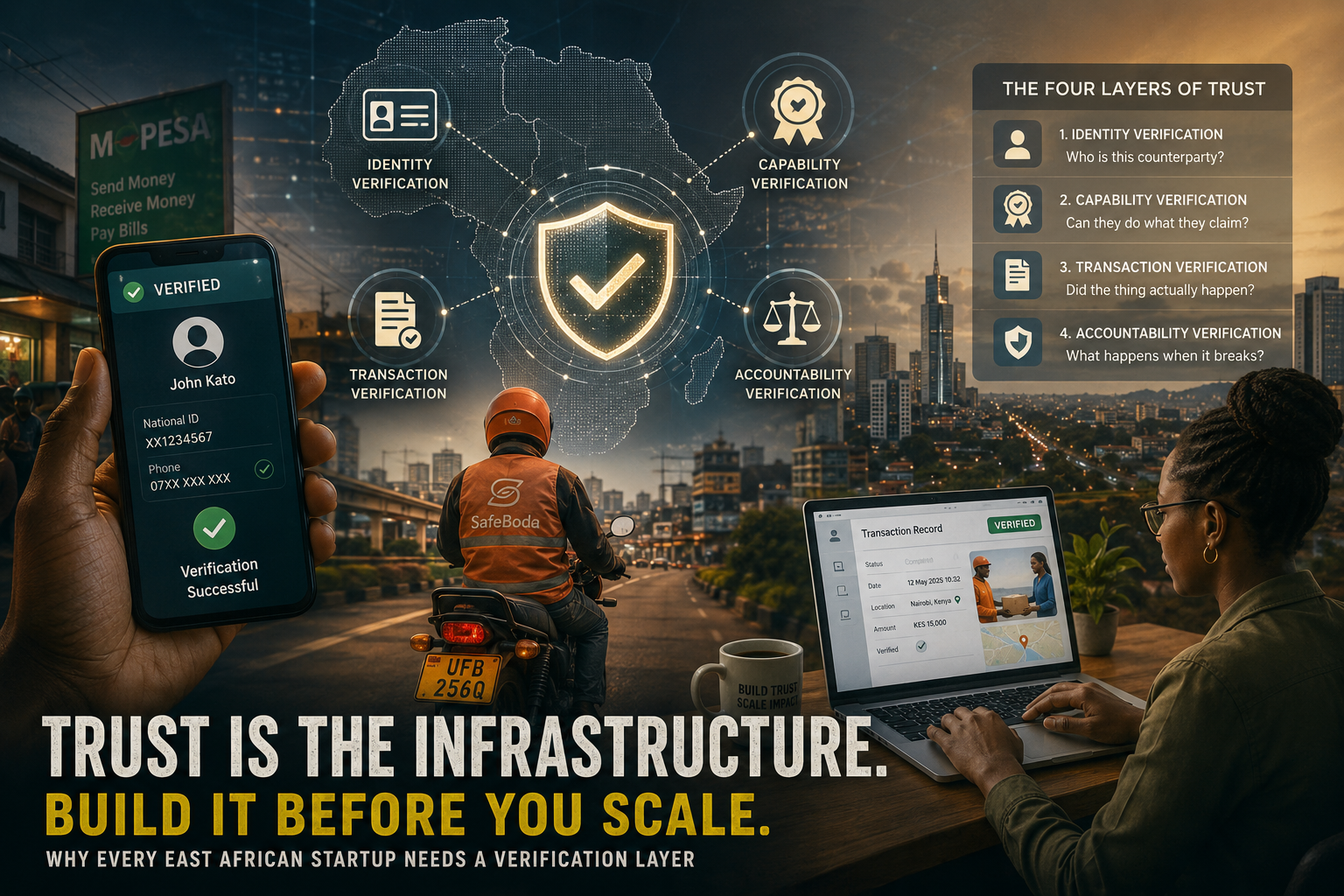
Let me define it plainly. Trust infrastructure is the set of verifiable answers a transaction needs before it can complete safely.
Every transaction, buying a plot of land in Wakiso, hiring a boda boda in Kigali, paying a plumber in Mombasa, sending a parcel from Kampala to Mbarara, turns on four questions:
- Who is this person, really?
- Can they do what they claim?
- Did the thing they promised actually happen?
- What happens when it doesn't?
In mature markets, banks, courts, credit bureaus, professional bodies and regulators answer those questions in the background. In East Africa, the answers are missing, partial, or paper-based. Which means founders building products here are not just building software. They are quietly being asked to build the verification layer the state did not.
This is hard. It is also where the durable companies are going to come from.
Why East Africa Amplifies the Problem
Three structural conditions make trust the central problem of building here.
The economy is informal first. The IFC estimates the informal sector represents 50–80% of GDP across East Africa. Most of your prospective customers, suppliers, and counterparties do not have verifiable corporate identities, audited financials, or filed tax history. You can serve them. But you have to verify them yourself.
Records are still paper-shaped. Land titles, business registrations, KYC documents, qualifications, medical histories, most of it exists, but it lives in physical files, on slow government servers, or in the WhatsApp screenshots prospective customers will send you. A startup that wants to verify any of this at scale has to build the verification pipeline before it can run the business.
Mobile money has trained customers to expect verification. And this is the part most founders miss. M-Pesa and MTN Mobile Money succeeded because they solved verification, every transaction returns a confirmation SMS, every recipient is identified by a registered SIM, every transfer leaves an audit trail your customer can screenshot. East African consumers are now allergic to platforms that feel less verified than mobile money. If your product cannot match the trust signal of a UGX 2,000 mobile money transfer, you are losing the comparison before you start.
The continent is not behind on trust. The continent is ahead on demand for it. The infrastructure has not caught up to the expectation.
The Four Layers of Verification
Whether you plan for it or not, you will build some version of all four. The question is whether you build them deliberately or accidentally.
Layer 1, Identity verification: who is this counterparty?
Not "what name did they type in the signup form." Who is the actual person or business behind this account?
The minimum stack for East Africa: National ID (NIN in Uganda, NIDA in Tanzania, Huduma Namba in Kenya, NID in Rwanda), a verified phone number with a registered SIM, and,for businesses, the URSB / RGB / BRS registration certificate. The good news: every East African country now has a digital national ID rail. The bad news: most startups still rely on a typed name and a phone number that may belong to anyone.
The cost of skipping this layer compounds. Your fraud rate is the floor on your unit economics. SafeBoda's rider verification, license, NIN, in-person onboarding, biometric check-in, is not a UX flourish. It is the reason a woman in Kampala will get on the back of a motorbike at 9pm with someone she has never met. The verification layer is the product.
Layer 2 Capability verification: can they do what they say?
Identity tells you who someone is. Capability tells you whether they can deliver. These are two different problems, and most startups conflate them.
A verified national ID does not tell you the boda rider knows the city. A registered business does not tell you the plumber can actually fix a geyser. A medical license does not tell you the doctor was struck off three years ago.
This is where review systems, qualification checks, sample work, performance scores, and bonding mechanisms enter the stack. Tugende built a financing business by verifying capability through driver work history, they did not just lend, they observed. Andela built a generational company by verifying engineering capability through a four-stage testing pipeline before any client ever touched a developer. The verification was the moat.
If your platform connects supply and demand, drivers, sellers, professionals, agents, providers, and you do not have a defensible capability check, your competitor will ship one and take your supply side overnight.
Layer 3 Transaction verification: did the thing actually happen?
This is the layer M-Pesa nailed and almost everyone else still struggles with.
In a high-trust market, a transaction record from any side is generally believed. In East Africa, a screenshot can be edited, a "delivered" status can be lied about, and a "completed" job can be disputed. You need a verifiable, third-party-signed record of what occurred, timestamped, GPS-stamped where relevant, image-verified where possible, payment-linked, and immutable enough that a dispute can be resolved in five minutes instead of five weeks.
The startups that built this well, Jumia's delivery confirmation flow after their fraud crisis, SafeBoda's trip records, Glovo's photo-verified handoffs, turned what looked like a UX problem into a defensibility moat. The ones that didn't are still paying customer service costs that shouldn't exist.
Layer 4 Accountability verification: what happens when it breaks?
The first three layers prevent problems. This one handles them.
Refund timelines. Dispute resolution. Escalation paths. Insurance. Bonding. Visible escalation to a real human in your timezone. If a customer cannot answer the question "what happens if this goes wrong?" before they pay you, they will not pay you twice, and most likely they will not pay you once.
This is where most East African startups under-invest, because accountability infrastructure is a cost line, not a revenue line. Until the moment it becomes the entire business. Ask anyone who has tried to scale a marketplace without a working refund and dispute mechanism. They will tell you the day it broke them.
The Hidden Cost of Skipping the Verification Layer
Let me give you the numbers we see in the field.
Across the East African SME and startup audits HanoHub has run over the last 18 months, the cost of a missing verification layer typically shows up as:
- 20–35% of customer service hours consumed by disputes proper verification would have prevented at signup.
- 8–15% of revenue lost to fraud, chargebacks, or refunds that traceable records would have resolved in minutes.
- CAC inflation of 1.4–2.2x because customers churn or refuse to refer when their first experience felt under-verified.
- 30–50% slower fundraising because investors performing diligence cannot get clean data on transaction integrity.
That last one is worth pausing on. The investors writing checks into African startups in 2025 and 2026 have already lost money on opacity. They are pricing it in. A founder who can demonstrate a clean, audited verification stack is now raising at a premium that did not exist three years ago. A founder who cannot is being asked questions they will struggle to answer.
Trust infrastructure is no longer a "nice to have when we mature." It is being underwritten in your term sheet.
What Founders Should Actually Do
Three principles, then I'll stop.
One. Treat verification as a product surface, not a compliance task. Make the verification visible to the customer. The reason mobile money works is that the SMS confirmation is the proof, and the customer can see it. If your verification happens in a database the customer never sees, you have spent the money without earning the trust. Build the receipt, the badge, the timestamp, the visible trail.
Two. Build the verification stack before you build the marketing engine. A platform that scales with weak verification is just a fraud accelerator with a marketing budget. Slow down for the first thousand transactions. Verify by hand if you have to. The patterns you see will save you when you automate.
Three. Pick the verification layer your competitor is weakest at, and own it. You probably cannot build all four layers to a 9/10 in year one. You can pick the one your market actually cares most about and be the obvious leader there. For boda apps, it is rider identity. For property platforms, it is title verification. For B2B marketplaces, it is counterparty payment history. Pick. Own. Be unambiguously the safest option in your category on that one dimension. The rest follows.
The Position We're Building From
At HanoHub, we build operational AI infrastructure for East African SMEs, and increasingly, for the startups serving them. Almost every system we deploy in 2026 now includes a verification component. Not because it was on the original brief. Because the operational drag we were hired to fix turned out, on inspection, to be a trust problem dressed up as a slow workflow.
A law firm losing 35% of inbound enquiries isn't bad at sales. It cannot verify which enquiries are real fast enough to respond. A clinic with a 12% no-show rate isn't badly run. It cannot verify intent to attend until the patient does or doesn't show up. A real estate agency converting 8 of 200 enquiries isn't weak on follow-up. It cannot verify which 30 of those 200 are serious buyers, so it treats all 200 the same, and the serious ones leave.
The whole continent is going to run on AI within the decade. That part is settled. What is still being decided is which African companies will build the verification layer underneath that AI, and which will rent it from someone else.
The companies that build it will define the next ten years of African tech.
The ones that don't are going to be very busy answering disputes.