The $60 Billion Blind Spot: Why the Money We Send Home Is Almost Never Verified
Every year, migrants send a staggering amount of money back
to Africa. They send it to buy land, to build houses, to fund family
businesses, to pay school fees, and to hold a place in the slow, patient plan
of one day going home.
Almost none of it is independently verified before it is
spent.
That is the gap this article is about, and once you see it,
it is hard to unsee.
The number that should give us pause
The scale is not anecdotal. According to the World Bank,
recorded remittances to Sub-Saharan Africa reached roughly $56 billion in
2024, up from about $55 billion the year before — and that is only the
money that moves through formal, traceable channels. The true figure is higher
once informal transfers are counted. Look at the continent as a whole and the
number climbs toward $90 billion a year.
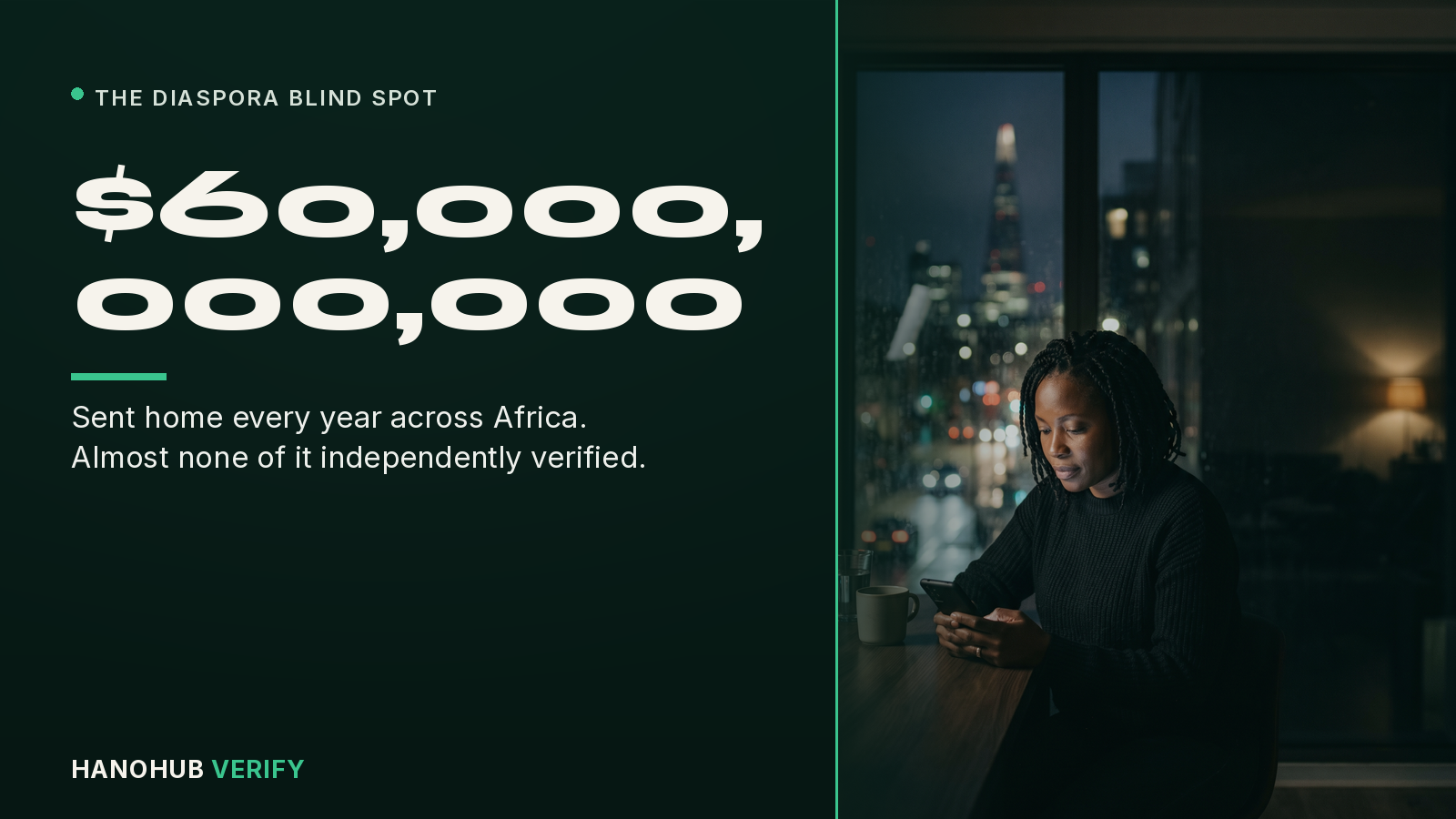
Call it sixty billion dollars, conservatively, flowing home
every year.
East Africa is one of the most active engines of that flow.
Kenya, Uganda, Tanzania and Rwanda have all posted strong remittance growth in
recent years. A meaningful share of that money does not stay as cash, it is
converted into land, buildings, and businesses, often managed by someone on the
ground while the person who earned it lives thousands of kilometres away.
Here is the uncomfortable part. We have built fast, cheap
ways to *move* that money. We have built almost nothing to verify what it buys.
Trust is not the same as verification
A family in London, Toronto or Dubai wires a decade of
savings toward a plot they have only ever seen in photographs. The title is
taken on trust. The contractor is taken on trust. The relative coordinating it
all is taken on trust.
Trust is not the problem. Trust is the most natural thing in
the world, and it is usually well placed.
But trust was never designed to do the job of verification.
A trusted person can be honest and still be wrong. They can be sincere and
still be deceived. They can mean every word and still lack the training to read
a title deed, the standing to demand a registry search, or the independence to
deliver bad news. Trust answers the question do I believe this person? Verification answers a different question entirely: is this actually true,
on paper and on the ground?
Those are two different skills. Confusing them is what costs
families their savings.
Distance is the real disadvantage
It is tempting to frame these losses as carelessness. They
rarely are. The people affected are often careful, intelligent and financially
literate. Their disadvantage is structural, not personal: they are simply too
far away to check.
From abroad, you cannot stand on the plot. You cannot walk
into the land registry. You cannot watch the foundation get poured, or notice
that the contractor's "team of twelve" is actually three men and a
wheelbarrow. You receive a curated version of reality, the photos someone
chose to send, and you make a five-figure decision based on it.
Distance, not intent, is the core vulnerability. And
distance is exactly what an independent verifier exists to close.
How the money quietly disappears
The losses tend to follow a small number of recognisable
patterns. We describe them here at the level of outcomes, because the
point is recognition, not a how-to guide:
Title problems. A deed can look completely
clean and still be forged, already sold to someone else, or quietly pledged to
a bank as loan collateral. A beautiful contract for a fraudulent title is still
a fraudulent transaction.
Construction abandonment. A house reaches sixty
percent complete, the deposits stop translating into progress, and the contractor
stops answering the phone.
Family misallocation. Money sent for one
purpose is absorbed by another, rarely out of malice, often out of pressure, and discovered only after it is gone.
Investment fraud. A convincing pitch, a
registration certificate, and a set of financials that do not survive an
independent check.
Every one of these is far cheaper to catch before the money
moves than to chase afterwards. By the time most families discover a problem,
the funds, and often the seller, are already gone.
What verification actually means
This is the gap HanoHub Verify was built to close. Not as a
broker, an agent, or a seller, as an independent check between you
and a decision.
In practice, that means a few non-negotiable things. Someone
physically visits the site and documents it with timestamped, GPS-tagged
photographs. The title is checked against the government registry itself, not
against a copy the seller handed over. Ownership history and encumbrances are
searched. The seller's identity is independently confirmed. The findings are
written up as a clear, evidenced report with a single risk score and a
plain-language recommendation on what to do next.
Crucially, an independent verifier has no stake in whether
the deal closes. Brokers, agents, and sometimes even well-meaning relatives all
benefit when the transaction goes ahead. That shared incentive is the quiet
risk in almost every diaspora deal. Independence is the missing ingredient and it is the whole point.
A clean verification does not guarantee a perfect outcome,
and it is never a substitute for a qualified lawyer's conveyancing. What it
does is replace hope with evidence, and reassurance with a documented record
you can act on.
A simple principle: verify first
The fix is not complicated. It is sequencing. Verify *before*
you send the money, not after you have lost it.
That single change, checking the facts before committing
the funds, is the difference between a confident investment and an expensive
lesson. The money you send home represents years of work. It deserves the same
diligence you would expect from any serious financial decision made closer to
home.
Frequently asked questions
**How much money does the diaspora send to Africa each
year?**
Recorded remittances to Sub-Saharan Africa were around $56
billion in 2024 (World Bank), and roughly $90 billion across the whole
continent, with the real total higher still once informal channels are
included.
What is diaspora property fraud?
It is the loss of money sent home for property or investment
due to issues such as forged or duplicate land titles, undisclosed
encumbrances, contractor abandonment, or fraudulent investment schemes, losses
made more likely by the buyer's physical distance from the asset.
Why can't a family member just verify the property for
me?
A relative can be completely trustworthy and still lack the
training to authenticate a title, the access to conduct a registry search, or
the independence to deliver an inconvenient finding. Trust and verification are
different skills.
What does independent property verification involve?
Typically a physical site visit with documented evidence, a
registry-level title check, an ownership and encumbrance search, independent
confirmation of the seller's identity, and a written report with a clear risk
score.
How long does verification take?
For a standard property check, usually three to seven
business days from the point all required information is provided.
Verify first.
Before you send money home, make sure what it is buying is
real. HanoHub Verify is an independent property and due-diligence service for
the East African diaspora, we have no stake in your transaction, only in the
truth of it.
Book a free 30-minute consultation to talk
through what you are considering, with no obligation to proceed.
Sources: World Bank Migration and Development Brief
(2023, 2024); World Bank press release, "Remittances Slowed in 2023,
Expected to Grow Faster in 2024." Figures are rounded and reflect
officially recorded flows; actual totals including informal transfers are
higher. This article is general information, not legal or financial advice.