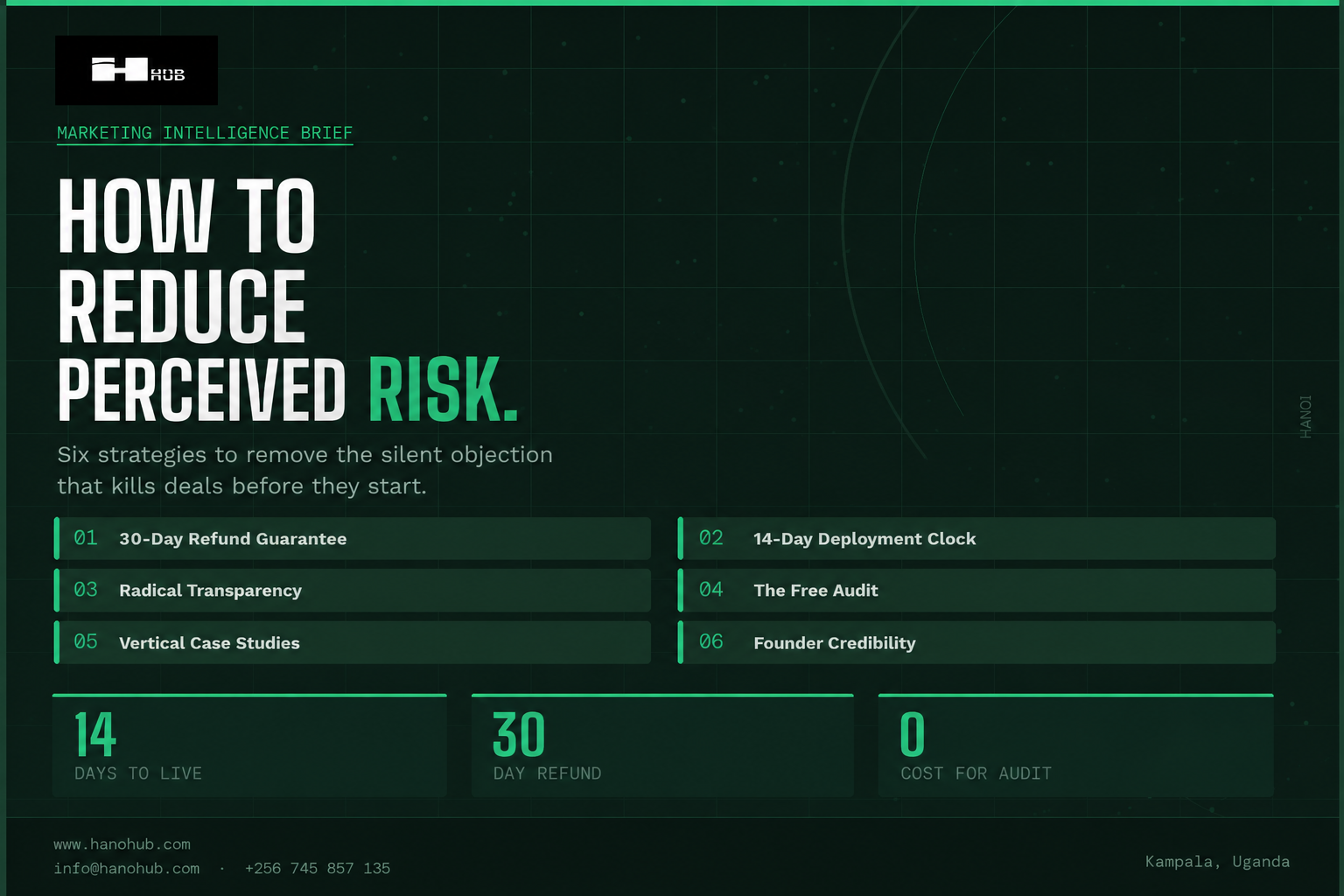
The 30-Day Refund Guarantee
This is HanoHub's most powerful risk-reduction asset — and it's written into every contract. If the deployed system doesn't move the agreed metric in its first month, the setup fee is returned in full. No arbitration. No clauses to argue. No small print.
Most businesses treat this kind of commitment as a legal safety net, buried in page six of a PDF. HanoHub puts it in the headline. That shift — from fine print to front page — changes how prospects read every other claim you make. It signals confidence, not desperation.
The 14-Day Deployment Clock
When a prospect sees a 14-day deployment promise, the subtext reads: this company has done this before. They know exactly what they're doing. Certainty about the timeline transfers directly into certainty about the outcome.
The 14-day clock is a cultural commitment at HanoHub — not a marketing line. Kickoff to a deployed, working system inside two calendar weeks, every engagement, every vertical. That consistency is what makes the promise credible. Any provider can say "fast" — the ones who mean it publish a number.
"Risk is reduced by evidence, not promises. Every claim HanoHub makes in marketing is followed by a number, a name, a process, or a guarantee."
Radical Transparency
HanoHub's positioning rests on a single internal principle: "We don't sell potential. We build systems." That is a risk-reduction statement disguised as brand voice.
Radical transparency means publishing what you do, how you do it, what it costs — and being honest when you're not the right fit. That honesty counterintuitively increases trust with exactly the right prospects. The ones who walk away weren't your clients anyway. The ones who stay trust you completely.
The Free Audit as a Zero-Risk Entry Point
The audit is already structured correctly — diagnostic, not commercial. The marketing job is to amplify that framing at every touchpoint so prospects feel safe enough to book it.
The right positioning: "The audit costs you nothing. What it costs us is 45 minutes of our best thinking — because we only offer it when we believe we can move a number for you." This flips the dynamic entirely. The free audit becomes a signal of HanoHub's confidence, not just a lead generation tool.
Vertical Case Studies
The objection case studies answer is not "does HanoHub work?" It's "does HanoHub work for a business like mine?" Generic social proof doesn't answer that second question. A case study from a law firm in Kampala does.
The most defensible moat HanoHub builds compounds with every client closed: vertical depth in case studies, playbooks, and sector trust that no new entrant can replicate quickly. This is both a sales tool and a competitive barrier.
Founder Credibility & Africa-First Design
For East African SMEs, the deepest perceived risk is hiring a provider who delivers a global template that doesn't account for WhatsApp-first behaviour, intermittent connectivity, local payment rails, or the trust dynamics of doing business in Kampala or Kigali. HanoHub's Africa-first design directly removes that objection.
This positioning pillar is the highest-defensibility asset in HanoHub's stack. It cannot be replicated by an entrant from outside the continent — and it becomes more powerful every time it's communicated consistently across every brand touchpoint.
The Risk Reduction Stack
Every objection a prospect feels maps to a specific answer HanoHub has already prepared. Here is where each answer lives in the marketing architecture:
| Risk the Prospect Feels | HanoHub's Answer | Where to Deploy |
|---|---|---|
| What if it doesn't work? | 30-day refund clause — written into every contract | Every CTA · Ad headline · Proposal cover |
| Will it take too long? | 14-day live deployment, every engagement | Landing page hero · Case studies |
| Can I trust these people? | Founder story, transparent audit, published values | LinkedIn · About page · Sales call |
| Is this right for my industry? | Vertical case studies — specific numbers moved | Proposals · Retargeting · Follow-up |
| Does this work in East Africa? | Africa-first design: WhatsApp, local infrastructure | All brand touchpoints |
| Is the price worth it? | ROI framing with before/after metrics | Content · Proposals · Sales deck |
